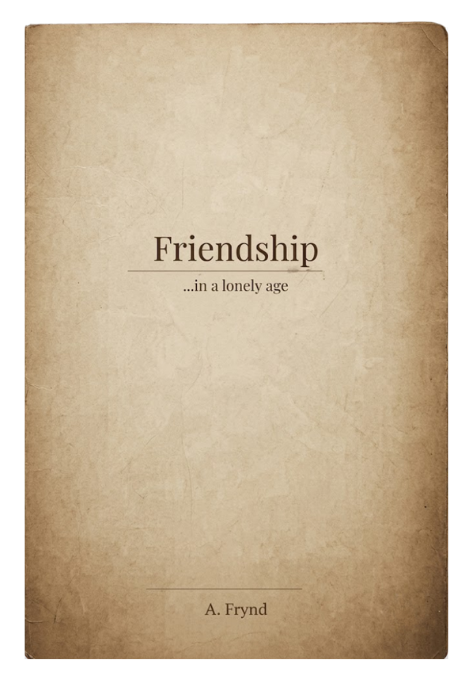
I picked-up this 10 chapter easy-read expecting a self-help book about making friends as an adult. What I got instead was something closer to a companion, and I mean that in a literal sense.
Author A. Frynd built this from real conversations with friends, more than two dozen of them, and it shows. When he asked people “What is friendship?” almost nobody gave him a definition. They gave him a memory, a confession, a regret. That choice sets the tone for the whole book.
It is not a treatise, but a gathering of testimony, woven together with Aristotle, Aelred of Rievaulx, Cicero, Whitman, and living voices like Richard Rohr, and somehow it never feels like name dropping. It reads like someone who has actually spent decades with these thinkers and finally found somewhere to put what he learned from them. I think he actually did!
Aelred's four tested qualities of friendship, loyalty, right intention, discretion, and patience, have stuck with me since I closed the book. So has the story of the author's boyhood friend Chaz, whose fried bologna sandwiches and quiet shelter from schoolyard bullies turned out to matter fifty years later.
Alma is the heart of the book for me, the spiritual director who became a friend and taught me to read slowly.
So is the chapter on friendship during illness, which draws on the AIDS buddy programs of the 1980s and does not look away from what it actually costs to stay present to someone who is dying.
The clearest statement of what the book is actually arguing shows up when Frynd retells the moment the Buddha corrects his attendant Ananda, who thought he was praising friendship by calling it half of the holy life. Not half, the Buddha tells him, the whole of it. Everything else in the book seems to build toward that line.
He does not spare himself either. The chapter on friendships that fail opens with a confession about a friend named Mo, someone who showed up for him for years until he let distance and his own exhaustion do what a real ending never did. He does not resolve it into a lesson. He just tells you it still grieves him. That same chapter, and the one on best friends before it, range from Elizabeth Barrett Browning's letters to Mary Russell Mitford, to James Baldwin and the painter Beauford Delaney, whom Baldwin called his spiritual father.
The book keeps insisting that this pattern—recognition, loyalty, showing up—is older than any of our labels for it, and by the fourth or fifth example you believe it.
I would gladly call this author my friend and feel blessed for it! It's a modern day Bible on Friendship!
Jayne Gumpel, LCSW, Co-Founder, Access Mindfulness